Immersive Shared Spaces: The Ultimate Guide
.jpg)



Immersive Shared Spaces: The Ultimate Guide
Immersive experiences aren’t just something you hold in your hand anymore. They’re not stuck inside a headset or trapped on a single screen. The most powerful experiences today are the ones you can actually walk into, together. Real, physical spaces brought to life with digital storytelling, designed for multiple people to explore at the same time.
Welcome to immersive shared spaces.
These are the kinds of environments where architecture, fabrication, content and technology all come together. Where the physical and digital don’t compete, they blend. And when it’s done right, it doesn’t just grab attention for a moment… it creates a place people want to step into. A destination.
At Aircards Studio, we’ve seen first-hand what happens when you get this right. Footfall turns into genuine engagement. Engagement turns into social amplification. And that amplification turns into measurable impact.
So let’s unpack it, what immersive shared spaces really are, why they matter more than ever, and how brands are using them to build worlds people don’t just pass through… but actually remember.
What Are Immersive Shared Spaces?
.jpg)
An immersive shared space is a physical environment brought to life with digital storytelling, designed for people to experience together.
It’s not a one-person AR filter or a solo VR headset moment. It’s something you walk into as a group. Something that surrounds you. Something that feels bigger because other people are inside it with you.
These spaces often combine things like:
- Wraparound LED environments
- Projection-mapped domes
- Mixed reality overlays
- Interactive public installations
- Shared XR storytelling moments
- Large-scale LED tunnels
- Intelligent screen environments
But the tech isn’t the point, the real difference?
They are designed to be experienced together.
And when you design for shared energy, for reactions, conversations, phones coming out at the same time and everything changes. The atmosphere shifts. The impact grows. And the memory lasts longer.
Why Immersive Shared Spaces Matter Now
We’re in an era where people genuinely crave being together in real spaces, but they still expect the richness and depth of digital.
Immersive shared spaces sit right in that sweet spot.
They naturally:
- Turn everyday locations into high-impact destinations
- Increase dwell time naturally
- Spark organic social sharing
- Create shared memory moments
- Extend reach beyond the physical footprint
And for brands, that changes the game.
Because suddenly, one well-designed space can deliver immediate live impact and long-tail amplification. The in-person experience fuels the digital ripple effect.
If you’ve read our guide to Immersive Event Experiences, you’ll know how powerful hybrid thinking can be at expos and live events. Immersive shared spaces build on that idea, moving beyond the booth, beyond the stand, and into something more architectural. More world-building. More story-led.
Hero Example: The Butterfly Trail @ Outernet
One of the clearest examples of a true immersive shared space is The Butterfly Trail at Outernet London.
Set inside one of the most advanced digital venues in the world, this experience combined:
- Wraparound Unreal Engine visuals
- Large-scale LED screens
- Spatial audio
- AR-powered narrative moments
- Real-time interaction
But what made it special wasn’t just the tech. Visitors didn’t simply watch the experience, they stepped into it.
The LED walls became a living, breathing ecosystem. Digital butterflies drifted across architectural surfaces. The entire space shifted and evolved with the story. And layered AR interactions pushed the narrative beyond the walls, giving people even more to explore.
This wasn’t a one-off activation or a single screen moment. It was a collective environment, built for scale, built for footfall, built for people to experience together. High dwell time. High shareability. High emotional impact.
The result? Millions of interactions and a cultural moment that lived far beyond the physical installation itself.
That’s what happens when immersive shared spaces are done properly.
Types of Immersive Shared Spaces
Not all immersive environments look or feel the same and that’s the exciting part. There isn’t one formula. Different spaces create different kinds of energy. Here are some of the most powerful formats brands are investing in right now…
1. LED Tunnels & Walkthrough Environments
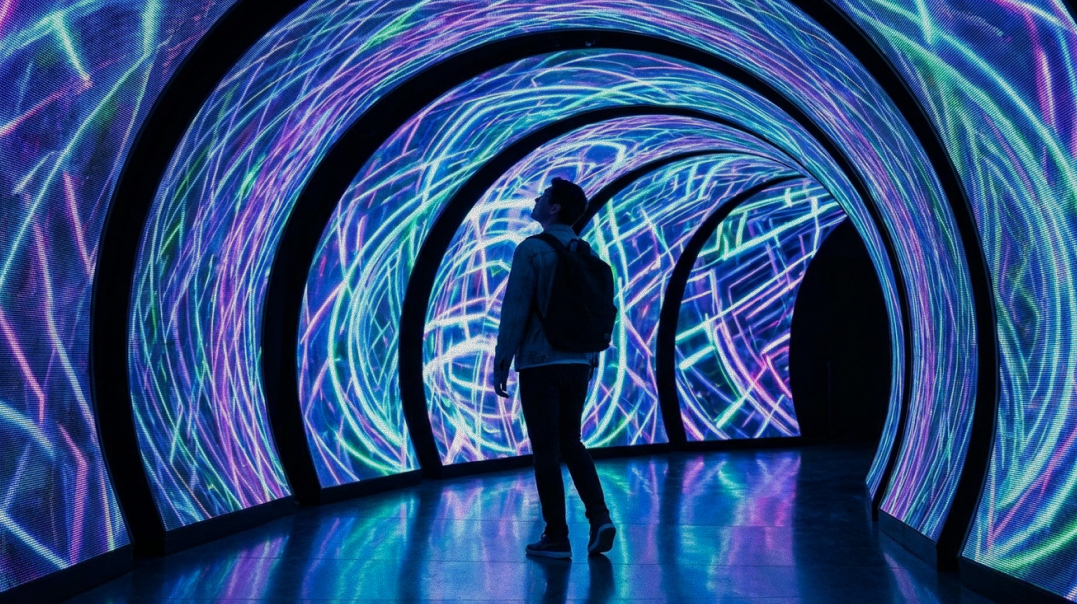
LED tunnels are one of the most visually striking forms of immersive shared space. You don’t just look at them, you walk through them.
Guests move through a corridor of light and motion. Content wraps around them. Audio syncs with visuals. The whole environment feels alive, dynamic, reactive, often driven by a story unfolding around you.
They’re particularly powerful for:
- Product launches
- Festival installations
- Retail entrances
- Expo centrepieces
Even without complex interactivity, the physical act of walking through a fully enveloped digital space creates a memorable shared moment.
2. Projection Domes & 360° Immersive Rooms
.jpg)
Projection domes and shared immersive rooms allow multiple guests to stand inside a fully surrounded storytelling environment.
Instead of watching content on a single screen, guests are surrounded by it. Walls become canvases. Ceilings come alive. Sometimes even the floor joins in. The whole room transforms into a single, cohesive narrative environment.
These spaces are particularly powerful for:
- Brand storytelling
- Cultural exhibitions
- Educational experiences
- Cinematic launches
When everyone looks up at the same time… when there’s a collective pause… when the whole room reacts in sync, that’s when the emotional impact multiplies. The experience doesn’t just land individually. It lands together.
3. Shared XR & Mixed Reality Environments
Shared XR is where the physical and digital really start to blur in interesting ways.
It brings together real-world sets and spaces with digital layers that everyone can access at the same time.
Using mobile devices, AR mirrors or large-scale screens, visitors unlock extra layers of content that live in the same physical environment, together. It’s not one person disappearing into a headset. It’s a shared discovery unfolding in front of a group.
This hybrid approach gives brands the flexibility to:
- Layer storytelling directly onto architecture
- Create scavenger-style narrative journeys through a space
- Add interactive digital depth to physical builds
It’s a natural evolution of immersive event experiences, but it can also live beyond the event itself. Done well, Shared XR becomes the bridge between temporary activations and more permanent, story-driven environments.
4. Retail as Immersive Shared Space
Retail is rapidly becoming one of the most exciting frontiers for immersive shared environments.
Take the Sephora x Rare Beauty activation in New York.
Instead of dropping in a single AR mirror and calling it a day, the entire flagship was reimagined as a connected experience. Visitors moved through a series of interactive touchpoints, with the AR Magic Mirror acting as a hero moment inside a much bigger branded world.
The lighting, the layout, the digital overlays, the physical build everything worked together. It didn’t feel like tech bolted onto a store. It felt intentional. Designed. Immersive.
The space felt less like retail… and more like an experience you wanted to explore.
The result?
Longer dwell time. A wave of organic social content. And a noticeable shift in brand perception toward something more premium and culturally relevant.
That’s retail as an immersive shared space not just a screen in the corner, but a fully connected environment.
The Role of Fabrication: Where Digital Meets Physical
Here’s where many immersive ambitions fall short.
Great digital content on its own isn’t enough. If the physical space doesn’t support it, the whole thing starts to feel disconnected.
This is exactly why The Workshop is such a core part of what we do at Aircards Studio.
By bringing fabrication in-house, we can design the physical and digital sides of a space together, not as separate workstreams trying to meet in the middle later.
- Physical builds are created with digital integration in mind from day one
- LED structures align with content storytelling
- AR anchors are engineered into the architecture
- Modular builds are designed to scale across multiple locations
- Experiences feel cohesive, not bolted together
When physical and digital are conceived together from the start, immersive shared spaces feel seamless. Effortless. Intentional.
When they’re not, you can tell. It feels layered. Added on. Slightly off.
And in immersive environments, that difference is everything.
Measuring the Impact of Immersive Shared Spaces
Immersion is powerful, but it can’t just look good. It has to perform. That’s where measurement becomes just as important as creativity.
Using tools like Metalitix™, immersive shared spaces can be measured through:
- Dwell time
- Movement heatmaps
- Interaction density
- Engagement touchpoints
- Content performance
- Flow analysis
Suddenly, you’re not relying on gut feel or social buzz alone. You can see how people move. Where they pause. What they engage with. What they ignore.
That shift turns immersive design from a creative gamble into a strategic asset.
Brands don’t just get spectacle.
They get insight.
What’s Next for Immersive Shared Spaces?
.jpg)
We’re only at the beginning.
The future will bring:
- AI-driven adaptive environments
- Persistent shared digital layers
- Real-time responsive architecture
- DOOH and immersive convergence
- Multi-location synchronised storytelling
Spaces won’t just display content.
They’ll respond, evolve and remember.
From Activations to World-Building
Immersive shared spaces aren’t just a trend, they signal a real shift.
They move brands beyond one-off activations and into spatial world-building. Instead of creating moments people pass by, they create environments people actively choose to step into, explore and share.
If immersive brand experiences are about emotional connection, immersive shared spaces are about collective immersion at scale.
At Aircards Studio, this is where creativity, technology and fabrication intersect. From Outernet-scale environments to retail flagships and immersive event builds, we design spaces that audiences don’t just walk through, they step into.
And when those spaces are cohesive, ambitious and measurable, they don’t just impress, they perform.
If you're looking to create an immersive shared space that feels cohesive, ambitious and measurable, we’d love to help bring that world to life.